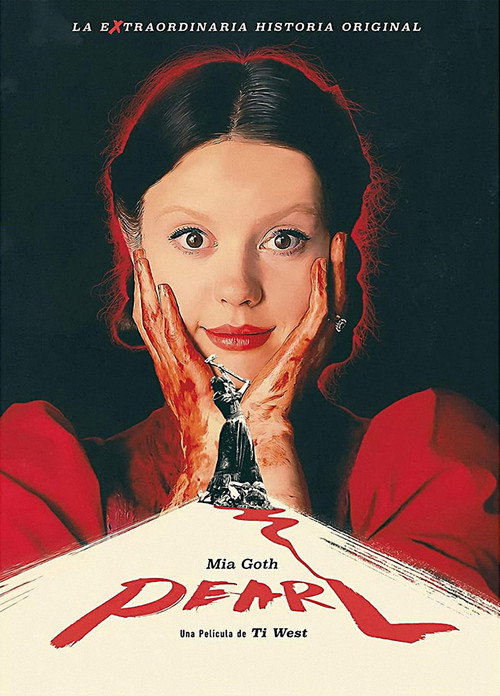
ACERVO · Pelicula · 2022
Perla
Pearl
Atrapada en la granja aislada de su familia, Pearl debe atender a su padre enfermo bajo la amarga y dominante vigilancia de su devota madre. Deseosa de una vida glamorosa como la que ha visto en las películas, las ambiciones, tentaciones y represiones de Pearl chocan.
Fuente: TMDB
* 7.2 (2784)DramaTerrorEstados Unidos
Directores
Paises
Estados Unidos
Estudios
A24 · Little Lamb Productions
Duración
102 min
Clasificación
16 años
Violencia ExtremaContenido Sexual
Estreno
16/09/2022
Puntuacion
7.2 / 10 (2784)
Donde ver
Streaming
 Netflix
 Netflix Standard with Ads
Alquiler
 Apple TV Store
 Amazon Video
Reparto









Aparece en listas





Comentarios
Inicia sesión para comentar y debatir sobre esta obra.
Cargando
Resenas de usuarios

Marco-Hugo Landeta Vacas
★ 8.0 / 10
(CASTELLANO) Pearl es una película difícil de colocar nada más terminarla. No es solo terror, no es solo una precuela, no es solo el retrato de una joven desquiciada. Es una película rara, enfermiza, muy consciente de su estilo y sostenida casi por completo por una Mia Goth absolutamente entregada. Puede gustar más o menos, pero cuesta negar que hay algo hipnótico en verla romperse por dentro mientras la película la rodea de colores, melodrama y una belleza casi de cuento podrido.
Lo más interesante está en ese contraste. Pearl parece mirar al cine clásico, a los musicales luminosos, a las granjas idílicas, a las fantasías de escapar y convertirse en alguien especial. Pero debajo de esa superficie bonita hay frustración, encierro, deseo, resentimiento y una soledad insoportable. La película juega precisamente a eso: cuanto más limpio y brillante parece el mundo, más sucio se vuelve todo por dentro.
Mia Goth es la película. Su interpretación tiene algo excesivo, teatral, incluso incómodo, pero esa exageración encaja con el personaje. Pearl no es una mujer “normal” perdiendo poco a poco el control; es alguien que vive atrapada entre un sueño de grandeza y una realidad que le queda como una jaula. Su rostro puede pasar de la inocencia a la amenaza en cuestión de segundos, y hay momentos en los que la película parece sostenerse únicamente en su mirada.
También funciona muy bien como reverso de X. No hace falta explicarlo todo ni convertir cada detalle en una justificación psicológica, pero sí añade una capa trágica y grotesca al personaje. Lo que en otra película podía parecer simplemente monstruoso, aquí se vuelve más triste, más humano y, por eso mismo, más perturbador. La película no pide que la compadezcamos sin más, pero sí nos obliga a mirar el origen de su resentimiento.
Eso no significa que sea perfecta. A ratos puede parecer más interesante como ejercicio de estilo que como relato de terror. Hay momentos en los que la película se recrea mucho en su propia rareza, y puede dejar una sensación fría, incluso distante. No siempre asusta en el sentido tradicional, pero sí incomoda. Y quizá ahí está su verdadera fuerza: no busca tanto el susto como la deformación progresiva de una mente encerrada.
Pearl es una película de terror extraña, hermosa y desagradable a la vez. Tiene algo de fábula cruel sobre los sueños rotos, la ambición, el deseo de ser vista y la violencia que puede nacer cuando una vida se pudre en silencio. No es una película fácil de resumir, y quizá por eso deja esa sensación de quedarse en blanco. Pero cuando una película te deja mirando al vacío, intentando ordenar lo que acabas de ver, algo ha hecho bien.
(ENGLISH) Pearl is a hard film to place immediately after watching it. It is not just horror, not just a prequel, not just the portrait of an unhinged young woman. It is strange, sickly, very aware of its own style, and held together almost entirely by a completely committed Mia Goth. You may like it more or less, but it is difficult to deny the hypnotic quality of watching her fall apart inside while the film surrounds her with color, melodrama and the beauty of a rotten fairy tale.
The most interesting thing is that contrast. Pearl seems to look back at classic cinema, bright musicals, idyllic farms, fantasies of escape and dreams of becoming someone special. But beneath that pretty surface there is frustration, confinement, desire, resentment and unbearable loneliness. That is exactly what the film plays with: the cleaner and brighter the world looks, the dirtier everything becomes underneath.
Mia Goth is the film. Her performance is excessive, theatrical, even uncomfortable, but that exaggeration fits the character. Pearl is not a “normal” woman slowly losing control; she is someone trapped between a dream of greatness and a reality that feels like a cage. Her face can move from innocence to threat in a matter of seconds, and there are moments when the whole film seems to rest only on her gaze.
It also works very well as the reverse side of X. It does not need to explain everything or turn every detail into psychological justification, but it does add a tragic and grotesque layer to the character. What could seem simply monstrous in another film becomes sadder, more human and therefore more disturbing here. The film does not simply ask us to pity her, but it does force us to look at the roots of her resentment.
That does not mean it is perfect. At times, it can feel more interesting as a stylistic exercise than as a horror story. There are moments when the film indulges in its own strangeness, and it can leave a cold, even distant impression. It does not always scare in the traditional sense, but it does disturb. And perhaps that is its real strength: it is less interested in jump scares than in the gradual deformation of a trapped mind.
Pearl is a strange horror film, beautiful and unpleasant at the same time. It has something of a cruel fable about broken dreams, ambition, the need to be seen and the violence that can grow when a life rots in silence. It is not an easy film to summarize, and perhaps that is why it can leave you blank. But when a film leaves you staring into space, trying to organize what you have just seen, it has done something right.

Thomas Ubieda 🍿
★ 8.0 / 10
Una precuela que vale la pena cada segundo. Terror psicológico con un pequeño toque de slasher bien ejecutado y narrativamente bien hecha. Pearl es una película espectacular en su enfoque. Ti West una vez más vuelve a sorprender por su gran nivel fílmico.
Mia Goth es la película en persona. Vaya interpretación, vaya personaje y vaya talento. Goth tiene el personaje de su vida y lo hizo fenomenal. Increíble lo que puede hacer, el cómo puede cambiar de expresión en pocos segundos y esa sincronía con cada escena. Nuestra protagonista te lleva por un vaivén de emociones y características psicológicas bastantes interesantes. Enriqueció al personaje y se demostró el nacimiento de la locura. Mia Goth nos dejó escenas muy memorables y que merecieron premiación.
Tandi Wright me pareció muy excelente en su rol como Ruth. Teniendo otra escena muy destacable y que te deja sin palabras. Agregó su toque mágico para nutrir la experiencia de la película.
La tonalidad de colores, la fotografía, la puesta en escena, el maquillaje, la banda sonora, el vestuario y ese cambio de escala entre escenas están excelentes, cada punto merece su aplauso!
Pearl es una cinta que abarca el tema psicólogo desde una perspectiva única y Mia Goth que lo hizo espectacular. Ese crecimiento de la pérdida de cordura está bien ejecutado, además, ese énfasis narrativo con el cerdo y el personaje de Pearl es magistral. Los sueños, la juventud, el amor, el deseo, la lujuria, la envidia, la inocencia, y la sangre son sinónimos de Pearl. Mia Goth te aporta eso y más.
Más que recomendaba. No es la mejor cinta, no tiene mucha sangre, pero en el aspecto psicológico es una joya. Quizá el único punto negativo fue que a diferencia de su antecesora, ésta no está en el mismo género. Lo argumentos son distintos y de igual manera su trama.
Inserte las expresiones de Pearl en los créditos.
Palabras clave
farmpornographydance performanceconfessiontexasdark comedybarnchildhood traumaprequelmurder