COLLECTION · Movie · 2026
Normal
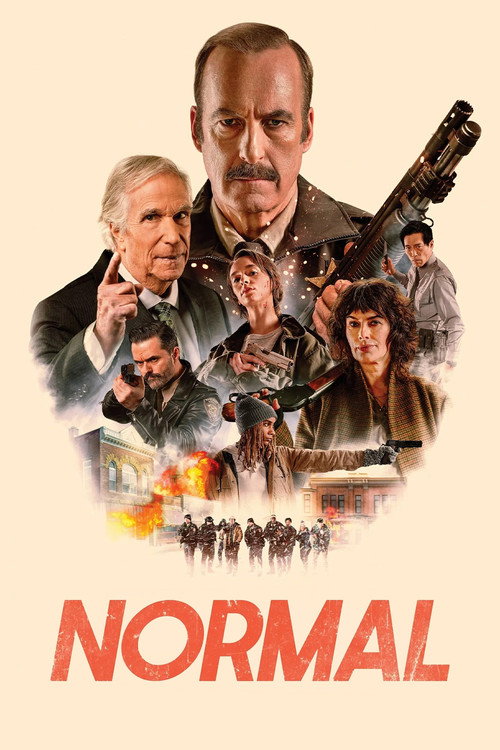
An unassuming substitute sheriff with a troubled past responds to a bank robbery in a small, sleepy town and unknowingly uncovers something far more explosive.
Source: TMDB
* 7.2 (667)ActionCrimeThrillerUnited States
Directors
Countries
United States
Studios
Aperture Media Partners · QWGmire · OPE Partners · Le Foole · Tradecraft · Normal Films
Runtime
91 min
Age rating
R
Extreme ViolenceStrong LanguageDrug Use
Release
16/04/2026
Score
7.2 / 10 (667)
Where to watch
 HBO Max Amazon Channel
 HBO Max
 Amazon Video
 Apple TV Store
 Fandango At Home
 Plex
PlexCast





Comments
Sign in to comment and discuss this title.
Loading
User reviews

Martin Oaks
★ 4.0 / 10
**The danger of NORMAL-izing the formula**
Ulysses Richardson (once again played by a circumspect and supposedly enigmatic Bob Odenkirk) is a lawman haunted by a turbulent past and deep personal crises who decides to take a temporary gig as acting sheriff in Normal, a sleepy, freezing Minnesota town. Looking for a breather from his marital struggles and inner demons, Ulysses hopes to find some peace in a seemingly quiet community. But, of course, that calm is shattered when he responds to a botched bank robbery, uncovering a massive, violent international criminal conspiracy involving the townspeople, the mayor, and even the Japanese Yakuza. It’s a total plot salad that traps the protagonist in a rat race where everyone wants him dead, forcing the taciturn sheriff to dust off his most lethal skills just to survive.
"Normal" is pure irony: a collision between Midwestern rural slice-of-life and hyper-violent grindhouse nihilism. However, under Ben Wheatley’s direction and with a script by Derek Kolstad (the mastermind behind the John Wick franchise), the movie falls short of its ambitions, delivering a monotonous and boring product. The script shows a blatant insistence on milking the contemporary Bob Odenkirk archetype. From his rise to fame in the "Better Call Saul" universe to his rebranding as an action hero in "Nobody" (2021) and its terrible sequel, the actor has perfected the mold of the middle-aged, reserved, unassuming, and drab guy—the classic neighbor no one would ever suspect, who happens to hide a savage military or criminal past and an alarming capacity for explicit violence.
In "Normal," this trope stops being a surprise and turns into a corporate formula. Ulysses Richardson is, essentially, the exact same character from his previous works: a vessel of apparent small-town calm who, at the first hostile trigger, flips a mechanical switch to start kicking ass and taking names with surgical precision. And frankly, it’s just exhausting. While Odenkirk carries the role with his usual weary, magnetic charisma, the total lack of new nuances makes his character arc feel incredibly predictable and redundant.
Ben Wheatley shows an alarming lack of identity here, though he never quite drops into the absolute dumpster fire that was "Meg 2: The Trench". The director who once blew us away with the dark humor and wickedness of "Sightseers" or the claustrophobic chaos of "Free Fire" seems to be running on autopilot here, serving the rigid blueprint of Kolstad and Odenkirk themselves. The action sequences are decent, but the script chooses to stack up bodies instead of exploring the town’s dynamics or fleshing out subplots that could have given the story more meat. It's a real shame, because the final result is incredibly mediocre and run-of-the-mill.
CinemaSerf
★ 6.0 / 10
I thought there something of the "Twin Peaks" about this as a temporary sheriff arrives in the town of Normal for a short stint following the untimely death of his predecessor. "Ulysses" (Bob Odenkirk) is about as laid back as a man can get, and so expects to do little in the sleepy town aside from settle squabbles between shopkeepers and listen to his deputy's squeaky leather jacket. Then the alarm in the bank goes off. Surely it's not being robbed? Anyway, his entire force race to the scene only to discover that - well that would be telling. Suffice to say, this new lawman finds himself in quite a predicament and with military grade hardware lined up against him; an unexplained giant pile of gold; an angry man with a sliced half-pinky and some very narked Yakuza heading to town, it looks like it's going to be a long night in Normal. Meantime we are treated to something of the obligatorily complex marital backstory from the sheriff as he strains to find an ally in this town that is so very much not what he'd (or we'd) come to expect. Odenkirk is a master at playing the understated character and he does that really quite well here, but the rest of the roles are a bit too undercooked. Just ask the "Fonz" himself (Henry Winkler) whose blink and you'll miss it effort makes very little impact in his snowy mayoralty. The last quarter of an hour is lively, messy and quite good fun and the whole ninety minutes passes along effortlessly enough, but I'm not too sure I'll remember this for very long - moose notwithstanding.

Sierbahnn
Enjoyable and refreshing.
There's a lot of police movie tropes that people revert to when writing their scripts. There's a certain amount of side characters, plots and twists you can introduce. This movie does something interesting with all of that and while the execution isn't flawless, it's still a very entertaining movie and its casting is phenomenal.
Parts of the movie are unbecomingly dark, which takes away from the action on screen as you simply cannot observe it. Other than that, I think it's a very technically proficient movie, and it is definitely funny enough to keep you engaged. The characters are interesting enough so that you get invested in them, which means that you care, and that builds the tension around them. I would say that this is a solid action movie and a far better cop movie than it initially presents itself to be.
J
jGZeYSJ51gZzqdrzwXJ7
“Normal” feels like a self‑conscious ‘woke’ spin on the modern action thriller, and for me that’s where it completely loses the plot. It plays as a politically one‑sided, ideologically heavy‑handed shoot‑’em‑up that’s more interested in attitude and messaging than in building believable characters or a coherent story. Asian yakuza are mostly reduced to stereotyped cannon fodder, while other characters are framed as more complex and sympathetic, which gives the violence a racially tone‑deaf, hypocritical edge instead of anything resembling clever satire. Even the better‑staged action beats can’t hide how thin, repetitive, and smug the whole thing is, so by the end I was just bored and irritated rather than entertained.
M
MovieGuys
★ 6.0 / 10
It could easily be said it's "normal" for Hollywood to shamelessly recycle winning ideas. Such is the case with action flick "Normal". This is essentially a re-skinned "Nobody". Same lead, essentially the same premise, of a seemingly easygoing character of no consequence, turning out to be a badass of considerable consequence.
It's blatantly lazily unoriginal, and yet it still works. Actions fast, pyrotechnical and bullet-ridden. The best part for me is "The Fonz", a smug character I've hated for years, getting blown up...ooooh, so satisfying!
In summary, nothing new on offer here. That said, the actions fast, explosive, creative and fun. Worth a look.
Keywords
small townsheriffbank robberysmall town sheriffcorrupt mayorsecret benefactorcriminal plotcriminal conspiracysmall town minnesota
Related links