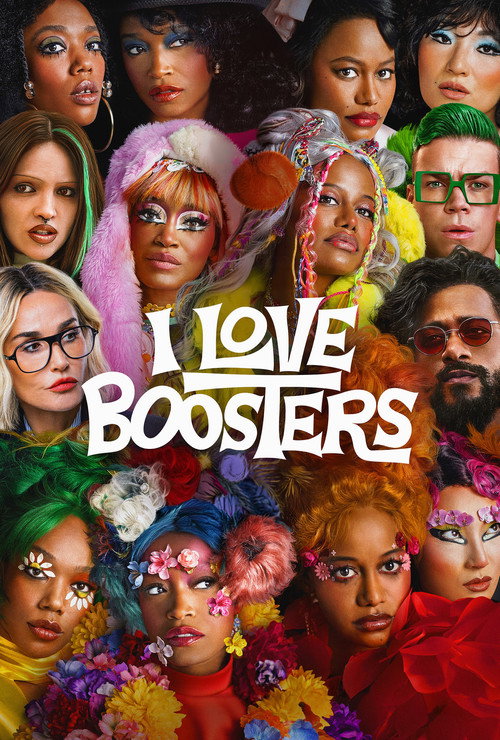
COLLECTION · Movie · 2026
I Love Boosters
A group of shoplifters take aim at a cutthroat fashion maven by stealing from her stores and reselling them at a lower price — what they call 'fashion-forward philanthropy'.
Source: TMDB
* 6.2 (118)ComedyCrimeScience FictionUnited States
Directors
Countries
United States
Studios
Savage Rose Films · Waypoint Entertainment · Ryder Picture Company · Annapurna Pictures · NEON · Metro Designers Productions
Runtime
113 min
Age rating
R
Sexual ContentViolenceExplicit SexStrong LanguageDrug Use
Release
21/05/2026
Score
6.2 / 10 (118)
Where to watch
 Amazon Video
 Apple TV Store
 Fandango At Home
 Plex
PlexCast







Comments
Sign in to comment and discuss this title.
Loading
User reviews

Yasmin J. Lee
★ 10.0 / 10
# Don’t Let "I Love Boosters" Be the Last Boots Riley Film You Watch
In this film’s opening image, Corvette waltzes into a nightclub and dances in the mirror alone. Suddenly, Pinky Ring Guy’s alluring stare draws her in. Even though his aura was undeniable, she shifts her sights onto a prospective buyer. Based on her lonely but ambitious entrance, Corvette is established as an entrepreneurial loner with intention. Corvette is a community builder, albeit a struggling one who cannot afford rent in Oakland. Class is the invisible hand that stops her from fully believing in herself, while capitalism is the game board she stands on.
This game she plays is simple. Exploit the laborers who make the profit possible and continue to steal resources or undervalue the resources enough to minimize expenses and consequences. Corvette, as a hustler, performs capitalism less greedily through her grassroots pathways. However, her methods are flawed. She lives in her own habitus composed of hijinx and high fashion, with very little insight about how the clothes she shoplifts were made in the first place. Her inadvertent ignorance gives way for self-evolution, friendship, and respect to arrive fashionably late while nuance is right on time. By acknowledging the contradictions and dialectics of creating art under capitalism, Corvette’s journey revealed her parallels to the antagonist the Velvet Gang aspires to become, Christie Smith (Demi Moore).
Corvette struggles with loneliness and glamorizes the designer world she has yet to join. She knows she’s a talented fashion designer, and she has a philanthropic cause, but she fails to acknowledge that she has enough to get where she wants to go. By overlooking her loyal community’s impact and hoarding her designs for herself, she manifests a sense of lack on her path—hence the ball of ATMs/Bills/Eviction Notices.
As the story progressed and Corvette’s wants and flaws surfaced, this motif made complete sense. Riley used absurdist imagery and well-rounded protagonists to convey the anxiety underprivileged creatives feel in this political world. “I Love Boosters” actualizes these anxieties, but not to pity them. He included them to categorically destroy it through activism. Depicting this ball of stress-inducing paraphernalia, Riley reinstates an artist’s power to disrupt the economic status quo. Corvette and the Velvet Gang were taunting Christie Smith’s monochromatic shops with their boosting to the point of her acknowledging them as her nemesis.
Once Corvette became a catalyst for anti-capitalist change alongside Jianhu (Poppy Liu), she evolved into a more empathetic leader. Her transformation is actualized when she uses the situational accelerator to unify the protesters at Christie Smith’s fashion show. It was in that moment that she realized her community and benevolence made her Christie Smith’s proletariat equivalent. So much so that Christie practically yielded to the Velvet Gang in the end. Boots Riley, as a filmmaker and comrade, intended his viewers to see that the people have the power, not the millionaires who benefit from the labor of their workers. However, Christie alludes to the fine line Corvette will one day walk on once she achieves the height of her success, bitterly warning, “You’re just fighting yourself.”
The Velvet Gang and Jianhu’s victories were only possible through the women’s honesty and vulnerability with one another. By overcoming the rabbit hole of worker mistreatment and unjust labor practices, constructing unity, Riley revealed how change is a path where multiple things are true at once, and desires are shared with layered voices all wanting one core thing: Collectivism.
“I Love Boosters” not only encourages viewers to harness their people power but also decorates the sentiment of whimsy with rebellion. To be whimsical is to be so aware of the distress that you opt to reimagine the world around you despite unrest and destruction. To little surprise, the costume designer of Boosters is the Academy Award-nominated costume designer and stylist, Shirley Kurata. Kurata designed the prolific costumes of “Everything Everywhere All At Once” and believes in harmonizing costumes with set decor. Considering her approach to costuming, she treated the costumes of the Velvet Gang as characters within the character.
Kurata explained on the In Proximity Media podcast show each of the characters’ personas and their textures. Corvette is the bookish leader who sports tweeds and somewhat unassuming fits. Mariah (Taylour Paige) is the edgy, cool, and vivacious booster in the bunch. Mariah’s costumes lean towards daring and revealing silhouettes. Sade (Naomi Ackie) is a single mother whose groundedness helps the gang course-correct. Sade’s costumes were directly inspired by the Oakland fashion scene. Jianhu teleported from China into Oakland. Based on where home is, Jianhu’s fashion was directly sourced from Chinatown to add that layer of Eastern streetwear and cultural integrity.
Kurata explains the Velvet Gang’s dynamically vibrant costumes had to explore a multitude of aesthetics as a mode of disguise. This Oakland heist film is helmed by emerging West Coast designers. Kurata worked with emerging designers to use her platform as a department head and revered creative to help launch the emerging designers’ careers.
Besides crafting the persona of the characters through costuming, “I Love Boosters” was a testament to temptation. In Riley’s film works, he typically connects sex to being a part of human nature. In “Sorry to Bother You,” Cassius Green (LaKeith Stanfield) literally drops into a couple’s bedroom in the midst of them climaxing. In the 2023 miniseries, “I’m A Virgo,” Cootie (Jharrel Jerome), a 13-foot-tall young man, and Flora (Olivia Washington) explore having sex as a newly committed couple. Considering the history of Black men in media being represented as one-dimensional, sterile, and asexual people who cannot show their desire to be wanted to avoid being seen as the animalistic and hypersexual other, it is believed that Boots Riley uses sex and pleasure as a necessary element in his narratives to humanize characters across cultures.
LaKeith Stanfield’s Pinky Ring Guy character represented Corvette’s yearning for romantic connection and pleasure. Pinky Ring Guy and Corvette’s natural attraction is overlooked by Corvette to reflect her internal battle of denying financial greed and sexual temptation, not because sex is a horrid act. Corvette denies herself of Pinky Ring Guy’s advances because it is not conducive to her pursuit of becoming a renowned Fashion Forward Filanthropist (I know how to spell it, but branding✨). There are debates about whether LaKeith’s horrifying cunnilingus scene was needed or if it was included for the sake of v-effect. Assuming Boots Riley uses sex in his media to convey a baseline for human nature and needs, it can be assumed the cunnilingus scene was his way of conveying Corvette’s need to deter distractions and patriarchal involvement that would ultimately drain her essence.
In the Baby, It’s Keke Palmer SXSW interview, hosted by the leading lady herself, Keke Palmer, the cast of “I Love Boosters” discussed their experience on set and collaboration with writer-director Boots Riley. Eiza González, who portrays Violeta Salt, made an excellent point explaining the difference between good directors and great directors. Great directors, like Boots Riley, are unafraid of collaborating with their cast instead of imposing on their actors’ performances. Naomi Ackie later affirms this by revealing that being a great actor means the talent is providing a service to open audiences to empathy and vulnerability in a vast array of worlds. Together, these points effectively show why “I Love Boosters” is an instant genre film classic that captures not only the magic of practical effects, set design, and costume design. It enraptures the audience in this ensemble of powerful women who will use their power to support their community on the West Coast and overseas.
It is a gahdamn miracle to see Keke Palmer be the star of yet another kick-ass sci-fi. She already won my heart in 2022 when she was Emerald in Jordan Peele’s “Nope.” In that role, she recreated the power slide on a [motorcycle from “Akira”](https://youtu.be/i-C9GaCgrMA?si=KpRZvmez55ghOGFj) in the middle of a rodeo family attraction! She was already legendary for that, but to think about her toting the situational accelerator and teleporting between China and a fashion show in America... I’m only in awe of her range and freedom as a performer.
Not to mention, I’m enjoying the convergence of Asian & Asian American, Pacific Islander talents collaborating with Black creatives. Last year, Ryan Coogler presented Helena Hu, Yao, and Li Jun Li as the Chows in “Sinners.” Their on-screen family ended up creating some of the most memorable moments in the film. Now, Boots Riley has introduced Alan Z, an Atlanta actor and rapper, and Poppy Liu to a new market of viewers. Poppy Liu & Alan Z’s scenes added a necessary texture to this tale of fashion and justice. A range of familial joy and grief was added with their presence.
Plainly, I must say, I’m stunned that the majority of people who watched this film have not seen a Boots Riley project before. Selfishly, it makes me sad and feel anxious because I want people to come back to his films more and give his Marxist commentaries space in their regular lives. However, after watching “I Love Boosters,” I hope any new viewers who’ve experienced the shock and discomfort of not knowing what was in store for them revisit this film with curiosity and wonder.
My review is a windy way of me saying... Boots is someone we must study as an artist, activist, and visionary as much as possible. Boots’s work is the cheat code for his viewers to be a part of the movement before they unknowingly join the oppressor.
*Enjoyed this review? Subscribe to my Substack (Snowy Reviews, by Yasmin) and give me a follow (@yasminthewriter) on Letterboxd, and see what I review next!*
B
Brent Marchant
★ 5.0 / 10
The power of film to make statements and to effect meaningful change is truly quite impressive. But it’s also possible for the impact of that influence to be diminished when a picture overstates its case, a problem that seriously hampers the latest feature from writer-director Boots Riley. This second offering from the filmmaker in many ways echoes themes introduced in his debut release, the deliciously satirical “Sorry To Bother You” (2018), with its poignant but deftly balanced messages related to social and economic fairness, personal ethics, and the business and political climate. However, in this case, the volume on these notions has been turned up considerably, to the point where it fundamentally screeches at the audience, no matter how much viewers may personally agree with the points the director is attempting to make. The film essentially follows the exploits of a group of “boosters” – designer clothing thieves – in the greater Oakland, CA area, led by aspiring designer Corvette (Keke Palmer) and her associates (Naomi Ackie, Taylour Paige). They target the retail outlets of iconic clothing creator Christie Smith (Demi Moore), a notoriously self-absorbed, self-important designer of overpriced clothing that she sincerely though euphemistically looks upon as “body art,” an element that she believes is integral to the evolution and advancement of society. Smith has made a fortune through her efforts (many of which are less than honorable), but she quietly seeks more than money: she lusts for power and control over her loyal and easily bamboozled customers and overworked employees, many of whom toil under deplorable conditions in manufacturing sweatshops in China. As revelations surface regarding Smith’s methods, things turn both personal and focused on bigger social and economic causes, especially when supported by idealistic aims at reframing injustices in all of these areas. This sets up factional; battlegrounds on multiple fronts to address these issues. Regardless of one’s personal opinions, the premise here would appear to be a somewhat noble one. However, it becomes mind-bogglingly overwhelming and tedious through a narrative that loses its way by becoming overstuffed with images, superfluous story threads, and initiatives that are difficult to track and differentiate from one another. Consequently, it’s easy to lose interest, particularly when storylines turn silly and the basic distinctions between reality and fantasy become irretrievably blurred (surrealism is one thing, but this is wholly over the top). The need for ruthless editing (not to mention major script revision) can’t be emphasized enough, no matter how laudable the underlying inherent notions might be. To its credit, when the picture works, it often succeeds brilliantly, especially in some of its biting one-liners, inspired sight gags, and performances by the likes of Moore, Chinese employee advocate Poppy Liu, and retail store manager Will Poulter, who uncharacteristically plays against type in his usual bad ass persona. The film also sports a stunningly colorful production design that’s a vibrant feast for the eyes. But there’s a lot lost here as well, primarily the result of a cloying story that quickly becomes more annoying than enlightening, some surprisingly cheesy special effects, and the generally poor use of cast members LaKeith Stanfield, Don Cheadle and the trio of boosters. While it’s readily apparent that director Riley is genuinely gifted when it comes to the range of his vision, passion and imagination, it’s also equally apparent that he needs to be seriously reined in rather than let loose without restraint (there’s that notion of knowing “when to kill one’s darlings” again). Looking back at the virtues of his vastly superior debut effort would make for a good starting point, an exercise that might help the filmmaker get his artistic and storytelling sensibilities back on track. I’m convinced Riley ultimately has much to say of great importance, but he needs to find more effective ways to say it, and “I Love Boosters” is definitely not the vehicle for that.
D
druscilla_of_old
★ 9.0 / 10
Three words: What! A! Feast!
My my my, where to start? I went into this one not knowing exactly what to expect and was deeply skeptical given that I'm not a fan of fashion movies and I'd not seen any Boots Riley movie. However, just fifteen minutes into the movie, all my doubts were excorcised and it just got better and better to the end. I mean, for instance, how many movies have you watched recently that had literal soul-sucking demons that were fashion models and gold-star medalists at giving head?
Out of caution not to spoil any of this wonderful feast for the curious viewers, I will not say any more except just to note that it has all the makings of a cult classic and is a masterpiece of modern cinema in its own right. If you're looking for a sumptuous comedy that makes you laugh throughout and that also ingeniously critiques the hell out of this hell-hole that is our global capitalist reality created and upheld by shallow, pretentious, and greedy billionnaires, please make sure to watch this one. Lovers of fashion will also find plenty to keep them gasping and searching for air as will fans of Keke Palmer who, without a doubt, derserves several awards for her performance. Personally, I know I'm gonna be rewatching this gift of a movie quite a number of times and I also have Boots Riley's previous movie on my watchlist now.
Consequently, I highly doubt that any of the "reviews" trashing on this classic are from good-faith audience members who actually watched the movie. For some reason - maybe it's because of the movie's unapologetic critique of capitalism or because of its leads being powerful black women or something related - there seems to be a conccerted campaign to censor or undermine the movie. This, of course, is yet another reason to watch it cause, you gotta wonder, why don't some powerful companies and people don't want us watching it?
That said, the only things that made me not give this a 10/10 were its promotion of drug (including alcohol) use and its casting of Demi Moore, an actor who has shown support for the Israeli genocidal occuption of Palestine in the past. Nonetheless, Boots Riley's and Poppy Liu's shows of support for Palestine are enough to at least limit my disappointment with Moore's presence in it.

ChristlichenSoldaten
★ 1.0 / 10
This is a low-IQ movie written by a low-IQ dummy for the lowest IQ zombies walking this earth.
One of the worst attempts at an artsy movie I've ever watched (part of anyway). Several people in the movie theater got up and left and we eventually did as well. Full disclosure: We live in a very nice part of the city, not anywhere near the ghetto part of town. I am sure in the dumb part of town they thought it was valid entertainment.
So to sum up, the mouth-breathing knuckle-draggers walking around our planet will clap like seals for this, and the rest of us will just star in amazement at their utter stupidity. 1/10 total trash.
F
flashgraatch
Well hurray, a movie about shop lifting meant to punish a successful person. The narrative of the have nots pursuing the destruction of the haves. I do not condone nor support this activity in life and I find it disgustingly glorified in this film. Pure offal! 0/10
Keywords
department storesurrealfashion designerfashionshopliftingclothesmacabreaftercreditsstingershoplifterabsurdism
Related links